Abstract
Capital preservation in real estate is often framed as a question of aesthetics and tenant perception. Over longer horizons, permanence is determined by physics. Bangalore sits on the Deccan Plateau at roughly nine hundred meters above sea level. The environment is defined by strong solar exposure, seasonal monsoon cycles, and a diurnal temperature range that commonly moves between ten and fifteen degrees Celsius. Buildings that respond to these forces with mass, shade, and durable assemblies tend to remain stable in comfort and operating cost. Buildings that resist these forces through thin envelopes and continuous mechanical correction tend to accumulate hidden liabilities.
The evidence suggests that glass intensive façades and synthetic cladding systems frequently represent a misalignment of capital in Bangalore. They increase cooling loads through solar heat gain, depend on sealants and coatings with finite service life, and shift performance risk onto mechanical systems. The more durable approach is restrained and technical. It emphasizes thermal mass, controlled fenestration, robust waterproofing, and structural design aligned to local geology. Permanence is therefore not a style. It is an engineered condition that protects asset value by reducing maintenance fragility and limiting mechanical dependency across a fifty year horizon.
Foundational Context
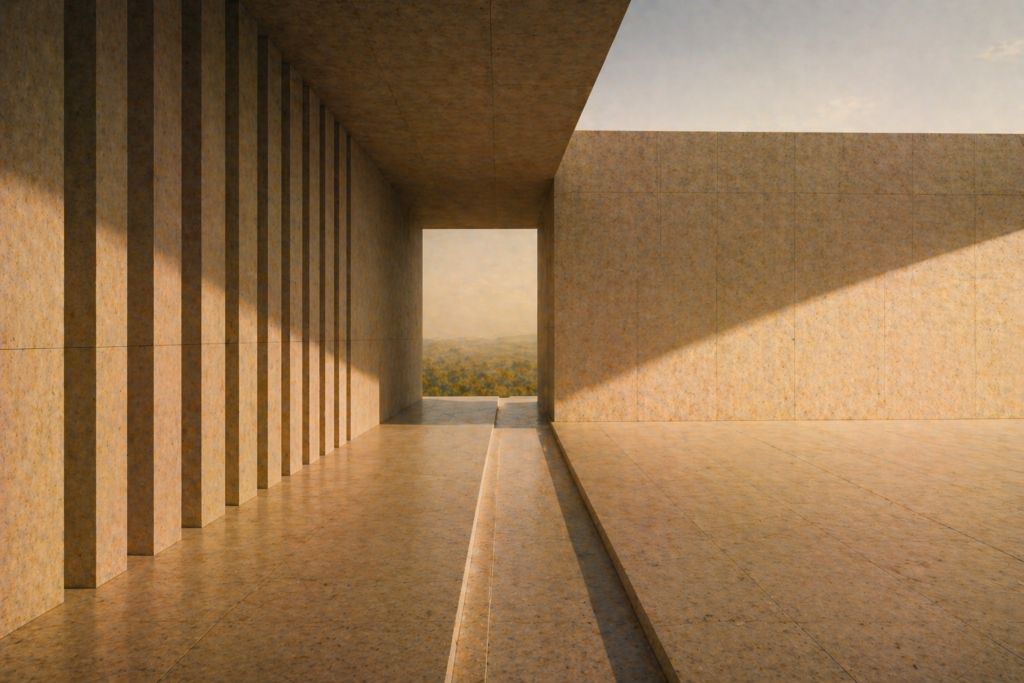
Bangalore’s older building stock contains a quiet lesson about place. In South Bangalore, particularly in Basavanagudi and Jayanagar, earlier residential and civic structures were shaped by what was available and what worked. Granite outcrops influenced construction culture. Thick masonry walls, stone plinths, shaded verandahs, and moderate openings created buildings that negotiated heat without constant machines. These were not designed as climate demonstrations. They were designed to remain habitable through the year with limited external dependency.
The city’s growth altered both architecture and incentives. From the late 1990s onward, commercial development accelerated along corridors such as Hebbal to the airport road and later the Outer Ring Road. Global enterprises brought a visual expectation formed in temperate climates. Developers responded with glass façades and lightweight cladding that signaled contemporaneity and scale. The construction economy also favored systems that could be repeated rapidly across large floor areas.
This shift produced an operational consequence that is now visible to anyone managing a building beyond its first leasing cycle. Thin envelopes amplify the plateau’s solar and temperature dynamics. Mechanical cooling becomes a baseline requirement rather than a supplement. The building’s performance becomes the performance of its machines.
We observe that many assets built fifteen to twenty years ago with aluminum composite panels, exposed sealant joints, and high window to wall ratios are already entering a phase of visible fatigue. Coatings degrade. Sealants fail. Water finds its way into façades and terraces. Repairs become repetitive because the underlying assembly was optimized for speed rather than service life. At that point maintenance begins to consume a disproportionate portion of yield.
The deeper issue is not that contemporary architecture is inherently fragile. It is that Bangalore’s environment punishes assemblies that depend on thin layers and proprietary parts. The plateau does not reward lightness unless that lightness is engineered with discipline. Over long horizons the market tends to separate buildings that age through patina from buildings that age through failure.
The Physical Architecture of Building Longevity
Building permanence emerges from the interaction of several physical systems rather than from a single design decision. On the Deccan Plateau three systems dominate building performance across long horizons.
The first system is thermodynamic behavior. Solar radiation, diurnal temperature variation, and wind patterns determine the energy required to maintain interior comfort.
The second system is geological stability. Soil bearing capacity, moisture behavior, and foundation interaction influence how a building settles and how structural loads are transferred to the ground.
The third system is material aging. Every assembly exposed to sun, rain, and thermal cycling experiences gradual degradation. The rate of that degradation determines whether maintenance remains predictable or becomes disruptive.
A building achieves permanence only when these systems are aligned. If the envelope amplifies heat gain, mechanical systems must compensate. If soil conditions are misunderstood, cracking and settlement emerge. If materials degrade rapidly, operating costs increase.
Architecture therefore becomes a negotiation with physics rather than an expression of fashion.
The Determinants of Building Permanence
Four physical determinants consistently shape the long term durability of buildings constructed on the Deccan Plateau.
Thermal Mass and Solar Control
Buildings that moderate solar heat gain through mass and shading reduce cooling loads and stabilize interior temperatures.
Geological Alignment
Structures that respect local soil conditions and foundation behavior experience fewer structural pathologies across decades.
Envelope Durability
Façades designed with durable materials and limited dependency on synthetic joints maintain structural integrity longer.
Mechanical Dependency
Buildings that rely excessively on mechanical correction systems accumulate operating risk and higher lifecycle costs.
These determinants operate together. Ignoring any one of them introduces fragility into the building system.
Technical Framework
Longevity on the Deccan Plateau rests on three technical domains. Thermodynamics shapes comfort and energy demand. Geology shapes structural behavior. Material durability shapes how assemblies age and how often they must be replaced. The National Building Code 2016 and Indian Standards provide the baseline, but permanence depends on how these ideas are integrated into design decisions.
Thermodynamics: Thermal Mass and Solar Gain
The diurnal temperature range on the plateau creates both a challenge and an advantage. When nights cool meaningfully a building can discharge heat if it is designed to store and release it. This is the central value of thermal mass.
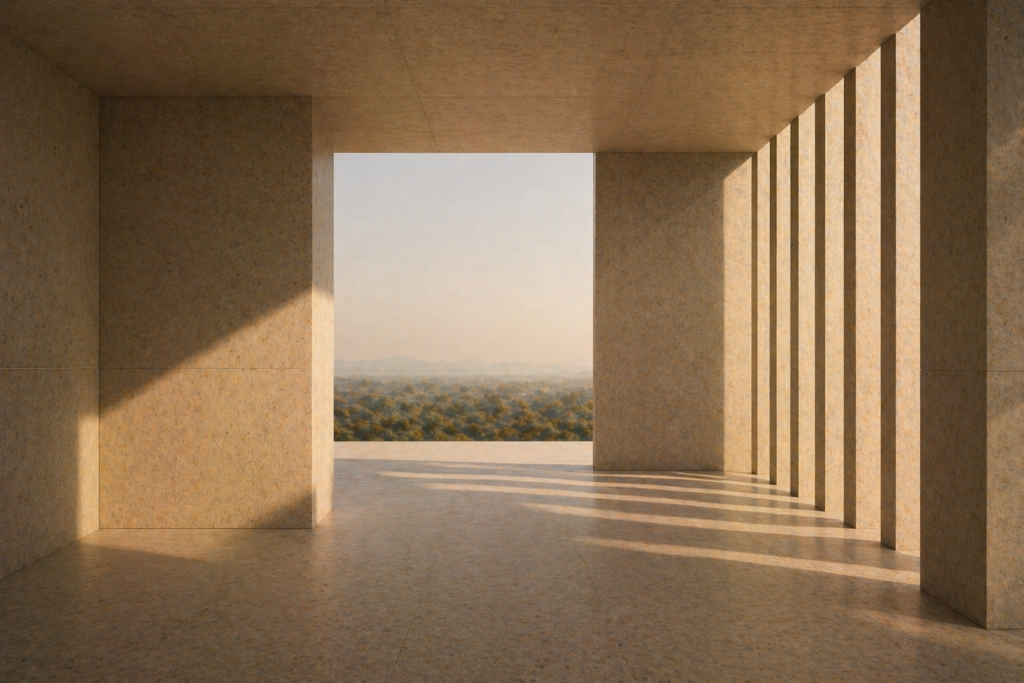
Materials such as granite, brick masonry, and reinforced concrete have high volumetric heat capacity. When used in sufficient thickness they dampen the temperature swing inside a building. Heat absorbed during the day migrates inward slowly. By the time the interior would otherwise peak the outside air has already begun to cool. This time delay reduces peak cooling demand and improves comfort stability.
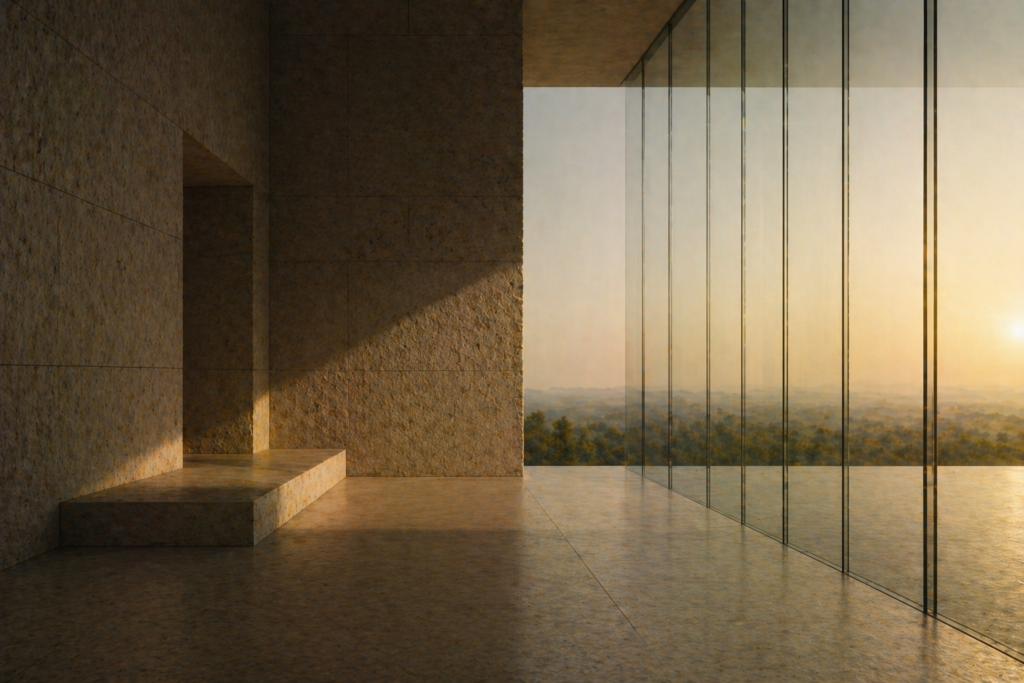
The main destabilizer in Bangalore is solar heat gain through glazing. Window to wall ratio therefore becomes a capital decision rather than an aesthetic flourish. High ratios increase solar load and internal glare, forcing larger HVAC capacity and increasing operating costs.
From a financial perspective this difference compounds over time. Buildings with restrained fenestration require smaller chillers, smaller electrical infrastructure, and lower annual maintenance expenditure. The capital invested in mass and shading therefore functions as an energy hedge rather than as a design indulgence.
Geology: Soil and Structural Stability
Structural longevity begins below ground. Much of Bangalore rests on the Peninsular Gneiss complex, a crystalline geological formation that produces the granite outcrops visible across South Bangalore and parts of the northern plateau.
In areas such as Basavanagudi and Malleshwaram foundations frequently encounter competent rock within relatively shallow depths. This geological condition historically enabled load bearing masonry and stable plinth construction.
However the city’s expansion into Whitefield and the Sarjapur belt encounters more heterogeneous soils including clay layers with variable moisture response. Buildings constructed in these zones require more careful foundation design because differential settlement becomes more likely when soil moisture fluctuates during monsoon cycles.
IS 456 governs reinforced concrete design and durability requirements including cover to reinforcement and mix design. Over long horizons concrete durability is often limited not by compressive strength but by reinforcement corrosion and cracking induced by moisture intrusion.
The evidence suggests that foundation stability and concrete durability are the hidden determinants of permanence in Bangalore.
Material Durability
The life of a building is not the life of its finishes. It is the life of its assemblies.
Synthetic cladding systems often fail this test. Aluminum composite panels and similar systems depend on sealants, fasteners, and subframes vulnerable to corrosion and ultraviolet degradation.
Glazing systems also carry finite service life. Sealants and gaskets eventually fail. Replacement becomes expensive because façade intervention requires specialized access and disruption to occupancy.
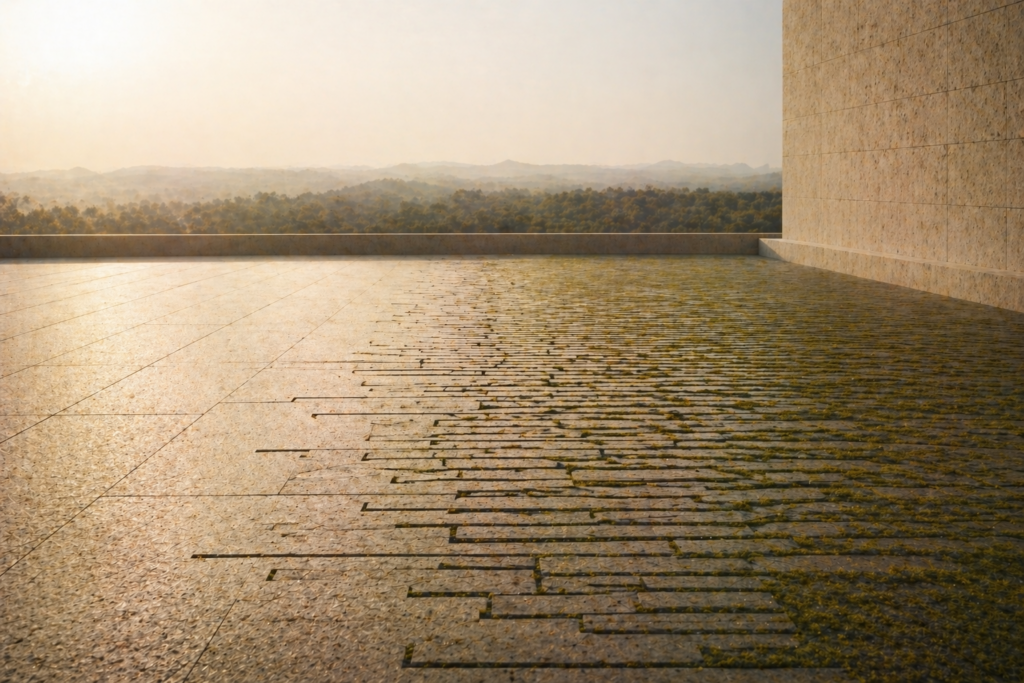
By contrast indigenous materials age differently. Granite, masonry, and lime plasters weather gradually without structural failure. Their aging produces patina rather than collapse. This difference determines whether maintenance remains manageable or becomes disruptive.
Strategic Interpretation
Many contemporary buildings in Bangalore represent an inversion of rational capital allocation. Money is spent on surfaces that depreciate quickly while core assemblies that determine long run performance receive limited attention.
Large glass façades promise visual openness and corporate identity. They also impose a permanent cooling liability. Over time this shifts a growing portion of yield into energy and maintenance.
Institutional allocators increasingly treat these patterns as risk rather than as modernity. Buildings that maintain stable interior conditions with lower energy intensity preserve tenant satisfaction and asset value.
Quiet architecture in this context is not stylistic restraint. It is a performance strategy that reduces moving parts and limits mechanical dependency.
The Risk Ledger
A long horizon diligence review should treat certain design choices as structural risk multipliers.
The Glazing Trap
High window to wall ratios increase solar gain and HVAC dependency.
Waterproofing Failure
Water ingress into concrete accelerates reinforcement corrosion and structural deterioration.
Cladding Fragility
Thin façade systems mounted on steel subframes often suffer hidden corrosion.
Mechanical Obsolescence
Complex proprietary systems create long term vendor dependency and replacement risk.
Each of these risks originates from design decisions made during early development stages.
Strategic Judgment
Permanence in Bangalore is best pursued as an engineering posture rather than as a design statement.
A disciplined allocator prioritizes thermal stability, structural resilience, and envelope durability. Buildings that combine high thermal mass, moderate fenestration, robust waterproofing, and geological alignment maintain comfort stability and lower lifecycle cost.
Indigenous materials often outperform synthetic systems because they degrade gradually and remain repairable decades later.
The most durable buildings are therefore not necessarily the most visually dramatic. They are the most technically coherent.
The Knowledge Architecture of Building Longevity
The principles outlined in this paper form the conceptual foundation for a broader examination of building performance within the STALAH Journal.
Supporting analyses explore subjects including:
- Thermal Mass in the Deccan Climate
- Stone versus Glass in Tropical Architecture
- Passive Cooling in Bangalore Homes
- The Physics of Cross Ventilation
- The Structural Life of Reinforced Concrete
- Foundation Design and Soil Conditions
- Fenestration Ratios and Solar Gain
- Landscape as Microclimate Control
- The Lifecycle Cost of Modern Buildings
Each of these subjects expands upon the physical systems described in this pillar article.
Closing Reflection
On the Deccan Plateau buildings reveal their true character slowly. The climate does not reward novelty. It rewards assemblies that endure solar exposure, temperature cycling, and monsoon stress without becoming mechanically fragile.
The measure of a permanent building is not its appearance at handover. It is its performance after decades of exposure and repeated use. Structures that rely on mass, shade, durable materials, and disciplined detailing tend to remain stable in comfort and cost. Structures that depend on thin envelopes and proprietary correction systems tend to accumulate compounding liabilities.
When architecture aligns with the plateau beneath it and the climate above it, the building becomes more than an object of design. It becomes a reliable container for time.
Related Reading
Frequently Asked Questions
What building materials perform best in Bangalore’s Deccan Plateau climate?
Bangalore’s climate — 18-35°C year-round with 900mm annual rainfall concentrated in the June-September monsoon — favours materials with high thermal mass and good moisture resistance. Exposed granite (abundantly available locally), 230mm thick burnt clay brick, and Mangalore clay roof tiles perform best. These materials absorb daytime heat and release it slowly overnight, reducing cooling loads by 15-25%. Red Shahabad stone for flooring maintains cool underfoot temperatures without mechanical cooling. Materials to avoid include thin painted concrete surfaces and large single-pane glazing, both of which create thermal discomfort and high maintenance cycles in Bangalore’s UV-intense, humid monsoon conditions.
How does Bangalore’s monsoon affect building envelope design?
The June-September monsoon drives building envelope requirements that differ from Bangalore’s otherwise mild climate: deep overhangs of minimum 900mm are needed to protect openings and facades from wind-driven rain; window reveals of 150-200mm reduce water ingress; APP or polymer-modified bitumen waterproofing membranes are required on all flat roofs and terraces; facade sealants must be elastomeric (not acrylic) to accommodate thermal movement and resist hydrostatic pressure; and exposed brick or stone must be treated with a breathable water repellent every 5-7 years. Buildings designed for Bangalore’s dry season without monsoon-specific detailing exhibit expensive facade and waterproofing failures within 3-5 years of construction.
Why do so many newer Bangalore buildings have high maintenance costs after five years?
The primary cause is specification trade-offs made during construction to reduce initial cost: exterior paints rated for 5 years chosen over elastomeric coatings rated for 8-10 years; APP membrane waterproofing omitted in favour of cement-based coatings that fail within 3-4 monsoons; window frames installed without adequate sealant backing rods; thin concrete cover over reinforcement (below IS 456’s 40mm for moderate exposure) that accelerates carbonation and rebar corrosion. These individual savings of ₹50-200/sqft in construction cost generate maintenance liabilities of ₹300-800/sqft by year ten. High-specification construction costs 8-12% more upfront but reduces 20-year lifecycle cost by 30-40% in Bangalore’s climate.
Architecture & Building Science: Complete Reading List
- Thermal Mass in the Deccan Climate
- Passive Cooling in Bangalore Homes
- Stone versus Glass in Tropical Architecture
- The Physics of Cross Ventilation
- Fenestration Ratios and Solar Gain
- Landscape as Microclimate Control
- The Lifecycle Cost of Modern Buildings
- The Structural Life of Reinforced Concrete
- Foundation Design and Soil Conditions
- Waterproofing Systems and Structural Durability
- Concrete Corrosion and Reinforcement Failure
- Thermal Expansion in Concrete Structures
- Seismic Considerations in Bangalore Construction
- Material Weathering on the Deccan Plateau
- Building Envelope Failures in Tropical Climates
- The Economics of Mechanical Dependency
- Retrofitting Aging Buildings
- Why Buildings Fail After Twenty Years
Arpitha is the founder of Stalah, a principal-led real estate house shaped by clarity, discretion, and long-term thinking. Her approach focuses on selective mandates, thoughtful representation, and measured real estate decisions.
Related Reading: