Contextual Opening
Our broader study of building permanence on the Deccan Plateau identified envelope durability as one of the four primary determinants of structural longevity. Within that broader category, waterproofing represents the most critical and most frequently neglected single system. Water is the primary agent of structural degradation in reinforced concrete buildings across all climate zones, and in Bangalore’s seasonal monsoon environment, the annual demand placed on waterproofing assemblies is intense. A waterproofing system that functions adequately for the first decade of a building’s life and then deteriorates progressively creates a trajectory of structural damage that becomes expensive to remediate and difficult to reverse.
Waterproofing failures are rarely visible at the point of acquisition. Water tracks through concrete and masonry assemblies in pathways that are not apparent from surface inspection. Internal moisture accumulation can persist for years before producing visible staining, efflorescence, or delamination. By the time visible evidence appears, the underlying structural damage is already underway. This pattern makes waterproofing condition assessment a specialist task rather than a general inspection observation.
The System Mechanism
Building waterproofing operates through two complementary approaches. The first is barrier waterproofing, which creates an impermeable layer that prevents water from penetrating through the assembly. Membrane systems, cementitious coatings, and crystalline products function as barriers. The second is drainage waterproofing, which accepts that water may enter a cavity or drainage layer and channels it away from the structure before it can cause damage. Cavity drain systems and tanked basements with drainage layers use this approach.
For above-grade roof waterproofing in Bangalore’s climate, the primary challenge is managing the combined effects of intense ultraviolet radiation during the pre-monsoon months and high water volume during the monsoon. Conventional bituminous membranes, which were widely used in buildings constructed through the 1990s and 2000s, have typical service lives of ten to fifteen years under tropical conditions before ultraviolet degradation and thermal cycling reduce their flexibility and produce cracking.
Indian Standard IS 3067 addresses the general design and installation of built-up waterproofing membranes. IS 13182 covers modified bitumen waterproofing membranes. More recently, liquid-applied polyurethane and polyurea membranes governed by relevant IS specifications have gained acceptance in the Bangalore construction sector. These products offer advantages in seamless application that eliminates the lap joint vulnerability of sheet membranes, but their performance depends critically on surface preparation and application thickness control.
The Administrative and Physical System
Roof waterproofing in commercial buildings in the Outer Ring Road corridor, Whitefield, and North Bangalore was typically installed as part of the original construction contract and has been exposed to Bangalore’s climate continuously since completion. Buildings completed between 1995 and 2010 that have not undergone membrane replacement are now operating with systems that may be approaching or exceeding their design service life.
The BBMP building regulations require that buildings obtain an occupancy certificate confirming compliance with approved plans before occupation. The occupancy certificate process includes inspection of structural elements but does not systematically assess waterproofing installation quality or test the assembly under simulated monsoon conditions. Waterproofing failures therefore frequently go undetected until the first major rainfall event after completion.
Terrace garden installations, which have become more common in both commercial and residential buildings as developers pursue green building ratings, place additional demands on waterproofing assemblies. The root barrier layer required beneath planting beds must remain intact to prevent plant roots from penetrating the waterproofing membrane. Root intrusion damage is typically slow but progressive, and the damage pathway is concealed beneath the growing medium. Terrace gardens therefore represent a higher-risk waterproofing context than unplanted exposed roof surfaces.
The Operational Consequence
Water ingress through roof membranes produces a cascade of consequences. Moisture penetrates into the concrete slab, reducing its thermal resistance and increasing the mass of water absorbed. In areas where the roof slab has reinforcement close to its upper face, moisture exposure accelerates carbonation and eventually corrosion. Staining and efflorescence appear on ceiling soffits below, reducing the quality of occupied spaces. Electrical systems and mechanical equipment installed in ceiling voids are exposed to dripping water, creating safety and equipment damage risk.
Basement waterproofing failures in commercial buildings create operational disruption to parking, service, and storage areas. In buildings with electrical transformer rooms, pump rooms, or data infrastructure located below grade, water ingress can produce service interruption with direct financial consequences. The cost of emergency remediation during a monsoon event is substantially higher than planned maintenance intervention.
For residential buildings in managed communities, waterproofing failures in common area roofs and external walls generate disputes between occupants and management committees regarding maintenance responsibility and cost allocation. When sinking fund reserves are inadequate to fund major waterproofing remediation, special levies are required that can create financial strain among apartment owners.
The STALAH Interpretation
In practice we observe that waterproofing assessment is inconsistently addressed in acquisition diligence. Physical surveys note visible staining and report whether the roof membrane appears intact based on visual inspection. They rarely include moisture content testing of concrete elements, infrared thermographic surveys to detect trapped moisture, or assessment of the waterproofing system’s age and type against expected service life.
A disciplined investor therefore requests documentation of the original waterproofing specification and installation date, the history of any remediation or replacement, and the results of any specialist waterproofing surveys conducted. Where this documentation is unavailable, an independent specialist survey including infrared thermography of the roof slab and targeted moisture content testing should be commissioned as part of diligence.
Over time the evidence suggests that waterproofing remediation costs in commercial buildings in Bangalore typically range from significant to very substantial as a proportion of the original construction cost, depending on the extent of underlying structural damage that has accumulated. Buildings with documented waterproofing maintenance histories and verifiable membrane service life remaining represent significantly lower acquisition risk than buildings where this information cannot be established.
The Risk Ledger
The parapet wall to roof junction represents the most common waterproofing failure location in Bangalore’s building stock. This detail requires the membrane to transition from horizontal to vertical and to be secured against wind uplift and thermal movement. When this detail is improperly executed or when the membrane loses adhesion at this location, water tracks behind the parapet coping and enters the wall cavity or slab edge.
Penetration waterproofing at service entries, drainage outlets, and roof anchor points represents another systematic vulnerability. The membrane must be carried up around each penetration and sealed against the penetrating element. Over time, differential movement between the membrane and the penetrating element opens gaps at these seals. In buildings with multiple penetrations from HVAC equipment, drainage stacks, and electrical conduits, the aggregate area of potential seal failures is significant.
Remediation cost escalation is a risk that arises when waterproofing failures are detected late. If water has penetrated into structural concrete to the point of causing reinforcement corrosion, the remediation programme must address both the waterproofing system and the structural damage. This requires removal of existing membranes, repair of damaged concrete, installation of new membranes, and in some cases structural reinforcement of corroded elements. The combined cost can be an order of magnitude greater than proactive membrane replacement.
STALAH Knowledge Graph Links
This analysis connects to the examination of the structural life of reinforced concrete, which identifies moisture penetration as the primary mechanism by which carbonation and corrosion degrade structural concrete over time. The treatment of concrete corrosion and reinforcement failure describes the structural consequences that follow from waterproofing failure. The examination of why buildings fail after twenty years situates waterproofing as one of the primary trigger mechanisms for accelerated building performance decline.
Practical Audit Questions
Questions a disciplined investor should raise include: What waterproofing system type was installed on the primary roof slab, and what is its age relative to expected service life. Has an infrared thermographic survey of the roof been conducted within the past two years to detect trapped moisture within the slab. Are there documented instances of water ingress into occupied or service spaces, and have these been remediated at the source or only at the manifestation point. What is the condition of waterproofing at parapet junctions and penetrations, and has this been assessed by a specialist contractor rather than a general inspector. For basement structures, has a drainage survey confirmed that tanking or cavity drain systems are functioning and that no active water ingress is occurring.
Related Reading
Frequently Asked Questions
How can a buyer identify waterproofing failures in a Bangalore building before purchase?
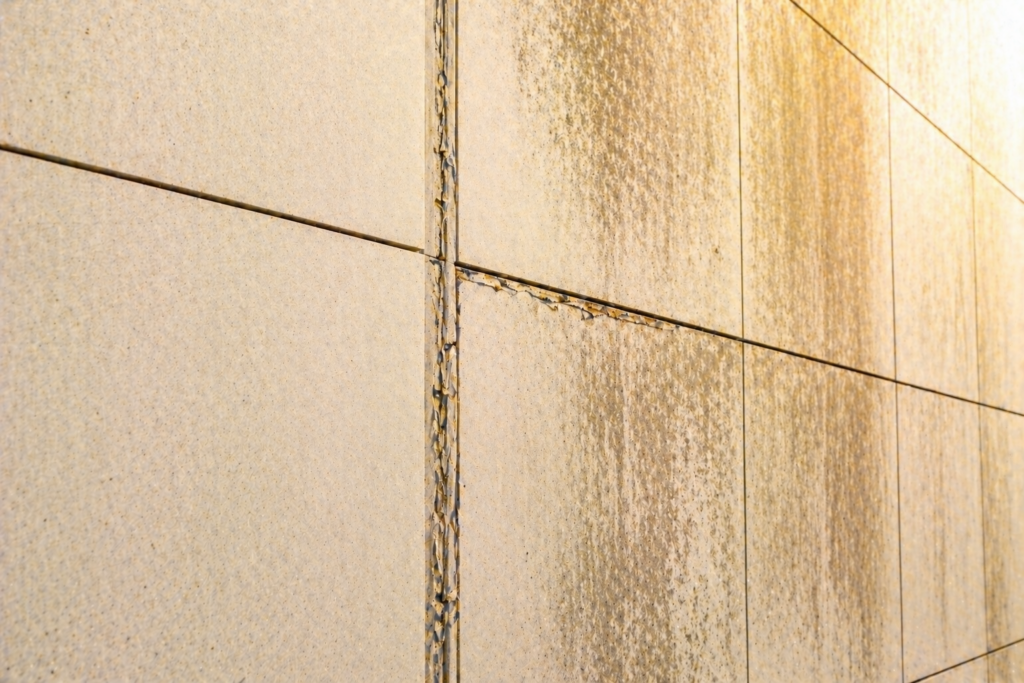
Waterproofing failures are visible through: yellow or brown stain patterns on ceilings below terraces and bathrooms; efflorescence (white salt deposits) on external walls — indicating water moving through masonry; peeling or bubbling paint on internal walls near external faces; damp, musty odour in basement parking levels; active seepage in stairwell walls adjacent to external facades; and rust-coloured streaks on concrete surfaces (indicating rebar corrosion driven by moisture intrusion). A monsoon-season inspection or a visit immediately after heavy rain is the most effective time to identify waterproofing failures that may be masked by dry conditions. Tap water test for basement walls: a wet cotton cloth placed on the wall and observed for 30 minutes — moisture migration indicates active seepage.
What is the cost of replying a waterproofing membrane on a Bangalore apartment building roof?
Replacing waterproofing membrane on a Bangalore apartment building terrace costs ₹150-250/sqft for crystalline waterproofing applied to a prepared surface, or ₹200-350/sqft for APP (Atactic Polypropylene) torch-applied membrane with protective screed — the preferred system for terraces subject to foot traffic and equipment loads. For a typical 20-unit apartment building with 4,000 sqft of terrace area, total waterproofing replacement cost is ₹6-14 lakh including surface preparation and protective screed. Re-waterproofing should be budgeted every 10-15 years for APP membranes and every 5-8 years for cement-based systems. Buildings that avoided proper membrane waterproofing in the original construction face higher repair costs due to concrete saturation requiring drying before membrane application.
Does RERA liability cover waterproofing defects in new Bangalore apartment buildings?
Yes. RERA Karnataka mandates a 5-year structural defect liability period from the date of Occupancy Certificate issuance. This covers “defects in workmanship, quality or provision of services” — waterproofing defects, particularly terrace and bathroom seepage, are explicitly covered by Karnataka RERA interpretations and tribunal orders. During the 5-year period, buyers can file RERA complaints requiring the developer to rectify waterproofing failures at no cost to the buyer within 30 days of notice. After the 5-year period, waterproofing repair responsibility transfers entirely to the residents’ association. Buyers discovering waterproofing issues in a building within the defect liability period should file RERA complaints immediately rather than accepting developer offers of in-kind remediation without formal process, as formal complaints establish a legal timeline for resolution.
Arpitha is the founder of Stalah, a principal-led real estate house shaped by clarity, discretion, and long-term thinking. Her approach focuses on selective mandates, thoughtful representation, and measured real estate decisions.
Related Reading: