Contextual Opening
Our broader study of building permanence on the Deccan Plateau identified the structural life of reinforced concrete as a fundamental but frequently underexamined determinant of building durability in Bangalore. Concrete has become the default structural material for virtually all buildings constructed in the metropolitan region across the past four decades. Yet the assumption that a concrete frame represents an indefinite structural asset is not supported by material science. Reinforced concrete has a finite service life governed by the rate at which chloride and moisture penetrate the cover concrete to reach the embedded steel reinforcement.
In Bangalore’s climate, which combines intense ultraviolet radiation with seasonal monsoon moisture cycling, the durability mechanisms that govern concrete service life operate under conditions that differ significantly from the temperate environments where much of the foundational research was conducted. Understanding these mechanisms is essential for any investor holding assets beyond a first decade of ownership or evaluating the residual structural life of existing buildings.
The System Mechanism
Reinforced concrete functions by combining the compressive strength of concrete with the tensile strength of embedded steel reinforcement bars. The alkaline chemistry of cement paste creates a passive oxide film on the steel surface that prevents corrosion under normal conditions. Structural degradation occurs when this passivity is disrupted, either by the ingress of chloride ions from external sources or by the carbonation of the cement paste, which reduces alkalinity and destroys the protective film.
Carbonation is the dominant corrosion mechanism in Bangalore’s inland atmospheric environment. Carbon dioxide from the atmosphere reacts with calcium hydroxide in the cement paste to form calcium carbonate, reducing the pH of the paste from approximately 12.5 to below 9. At this pH, the passive film on the reinforcement becomes unstable. The rate of carbonation follows approximately a square root of time relationship: carbonation depth increases proportionally to the square root of exposure duration.
Indian Standard IS 456:2000 governs the design and detailing of reinforced concrete structures in India. The standard specifies minimum cover to reinforcement based on exposure condition. For moderate exposure, corresponding to typical sheltered internal conditions, a nominal cover of thirty millimetres is specified. For severe exposure, corresponding to exposed external conditions with regular wetting and drying, a minimum cover of forty-five millimetres is specified. In practice, cover achievement in construction is variable, and cover below specification accelerates carbonation penetration to the reinforcement.
The Administrative and Physical System
Concrete mix design is the primary variable determining carbonation resistance. Higher cement content mixes with lower water-cement ratios produce denser paste microstructure that slows carbon dioxide diffusion. IS 456:2000 specifies minimum cement content and maximum water-cement ratios for each exposure class. For severe exposure conditions, a minimum cement content of 320 kilograms per cubic metre and a maximum water-cement ratio of 0.45 are required.
In Bangalore’s construction sector, ready-mix concrete supply has expanded significantly across the past two decades. Plants operated by major suppliers including ACC, Ultratech, and regional producers supply concrete to developments across the metropolitan region from facilities in Dobbaspet, Electronic City, and the Hoskote industrial area. Ready-mix supply improves mix consistency relative to site-batched concrete, but water-cement ratio control during placement and workability adjustment in transit remain potential sources of variability.
Structural survey methodology for existing reinforced concrete buildings includes phenolphthalein indicator testing to measure carbonation depth, half-cell potential measurement to assess corrosion probability of reinforcement, and cover measurement using electromagnetic cover meters. These tests, conducted systematically across a building’s exposed concrete elements, provide a factual basis for estimating remaining service life rather than relying on age alone as a proxy for structural condition.
The Operational Consequence
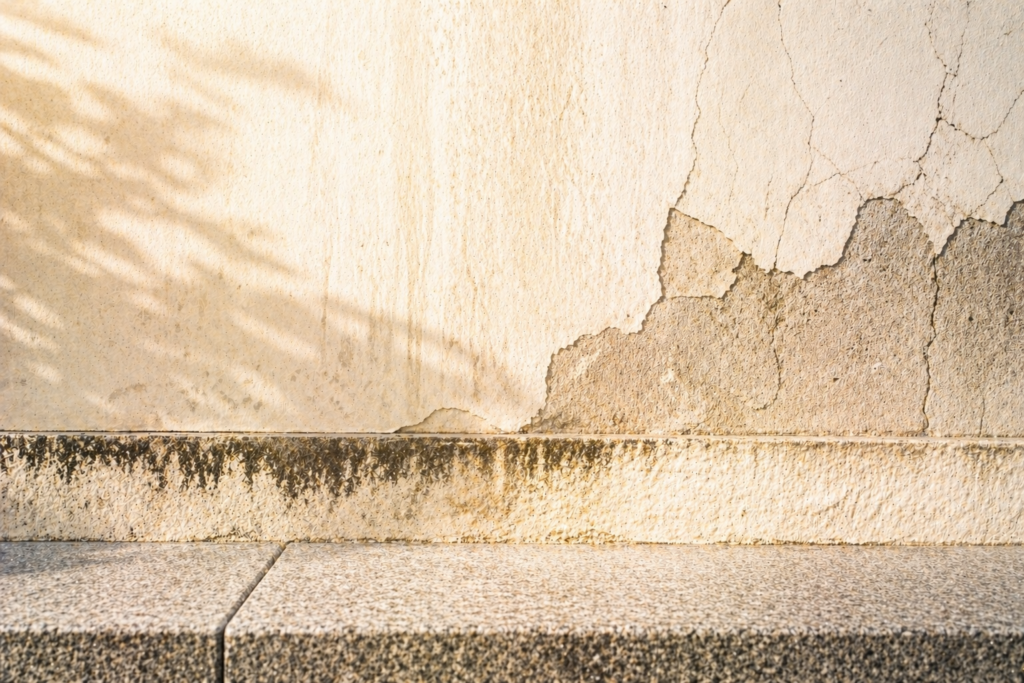
The consequence of reinforcement corrosion progresses in stages. Initial corrosion is invisible externally but is detectable by half-cell potential measurement. As corrosion products accumulate, they expand within the concrete cover, creating tensile stress that eventually produces cracking. Cracks appear on the concrete surface along the line of the reinforcement. Once cracking begins, moisture and carbonation agents gain direct access to the reinforcement, accelerating corrosion. Delamination and spalling of cover concrete follow, creating safety risk and requiring immediate remediation.
The cost of concrete remediation increases dramatically with the stage at which intervention occurs. Surface-applied carbonation-inhibiting coatings applied before carbonation reaches the reinforcement are relatively inexpensive. Patch repair of localised spalling is moderately expensive but manageable within normal maintenance budgets. Widespread delamination requiring full-depth concrete removal and reinstatement of cover across structural elements is a major intervention that may approach or exceed the economic value of the building in extreme cases.
Buildings constructed in the early phases of Bangalore’s commercial real estate expansion, approximately between 1990 and 2005, are now entering the age range at which carbonation-induced corrosion begins to produce visible consequences in buildings with below-specification cover or inadequate concrete mix design. These buildings represent a significant portion of the established commercial stock in Whitefield, parts of the Outer Ring Road, and the older precincts of Electronics City.
The STALAH Interpretation
In practice we observe that concrete durability is one of the most systematically neglected aspects of acquisition diligence in Bangalore’s commercial real estate market. Buyers commission structural surveys that confirm load-bearing adequacy and note visible cracking but rarely include carbonation depth measurement or half-cell potential assessment as standard items. The result is that structural condition is assessed by appearance rather than by material state.
A disciplined investor therefore extends structural diligence to include non-destructive durability assessment when evaluating buildings constructed more than fifteen years ago. Carbonation depth measurements taken at representative locations across external and exposed concrete elements, combined with cover measurement, provide a basis for estimating the time before corrosion activation. This estimate, combined with the building’s maintenance history, informs the lifecycle cost projection for structural remediation.
Over time the evidence suggests that buildings constructed with high-quality concrete mix design and adequate cover to reinforcement demonstrate structural longevity that extends well beyond fifty years with normal maintenance. Buildings with compromised concrete quality or inadequate cover begin to show structural maintenance demands within twenty to thirty years. The difference in construction cost between these two outcomes is typically modest relative to the lifecycle cost divergence.
The Risk Ledger
Construction period cover deficiency is the most significant hidden structural risk in existing buildings. Cover meters provide retrospective measurement but cannot determine whether low cover was consistently applied across the entire structure or localised to accessible positions. Statistical sampling across multiple elements at different heights and exposures is required to characterise the cover distribution adequately.
Waterproofing failure at roof slab level introduces localised chloride and moisture loading that accelerates corrosion in top floor slabs and parapet structures. The junction between roof waterproofing and parapet wall is a consistently problematic detail in Bangalore’s construction sector. When waterproofing fails at this junction, water tracks along the top of the slab and penetrates into areas of compromised cover.
Post-tensioned concrete structures, which are used in long-span floor systems in some commercial buildings, carry specific durability risks at tendon anchorage zones and along duct grouting. Inadequate grout injection during construction can leave voids around tendons that concentrate moisture and chloride exposure. Assessment of post-tensioned systems requires specialist investigation beyond standard structural survey methodology.
STALAH Knowledge Graph Links
This analysis connects to the examination of waterproofing systems and structural durability, which addresses the primary mechanism through which moisture gains access to reinforced concrete elements. The treatment of concrete corrosion and reinforcement failure extends the durability mechanisms described here into specific failure patterns and remediation approaches. The examination of the lifecycle cost of modern buildings situates structural durability within the broader capital obligation framework for building ownership.
Practical Audit Questions
Questions a disciplined investor should raise when evaluating existing reinforced concrete buildings include: Has carbonation depth been measured at representative external and exposed concrete elements, and what is the carbonation front depth relative to the specified cover. Has half-cell potential measurement been conducted to assess corrosion probability of reinforcement. What concrete mix design and cover specifications were used in construction, and can this be verified against original structural drawings and site quality records. Are there any locations of existing cracking, delamination, or spalling, and has the structural cause of these defects been investigated. Has the roof waterproofing been replaced within the past fifteen years, and is there evidence of moisture penetration into roof slab concrete.
Related Reading
Frequently Asked Questions
What is the expected structural lifespan of a reinforced concrete apartment building in Bangalore?
An RCC apartment building designed and constructed to IS 456:2000 with M20 minimum concrete grade, adequate cover (40mm for moderate exposure), and proper curing practices has a design life of 60-80 years in Bangalore’s mild climate. The primary life-limiting factor is carbonation — CO₂ from Bangalore’s relatively clean air slowly neutralises the alkaline protection around steel reinforcement, advancing the corrosion front over 40-60 years. Buildings constructed before IS 456:2000 revisions (pre-1978 code era) or with documented cover deficiencies may have effective structural lives of 40-50 years. Regular carbonation depth testing from year 25-30 onward allows proactive intervention before the carbonation front reaches the reinforcement.
What concrete grade is required under IS 456 for residential construction in Bangalore?
IS 456:2000 (Plain and Reinforced Concrete — Code of Practice) specifies M20 as the minimum concrete grade for reinforced concrete in moderate exposure conditions, which covers most Bangalore residential construction. M25 is required for elements in severe exposure conditions — basements, ground-level slabs, and columns in areas with aggressive groundwater. For high-rise buildings above G+7 stories, M30 or higher is typically specified for structural efficiency in columns and walls regardless of IS 456 minimums. RERA Karnataka requires developers to disclose concrete specifications in project documents; buyers of under-construction apartments should verify that actual concrete cube test reports match the specified grade — a critical quality control step that is often not performed by buyers.
How can a buyer assess the structural health of a 15-year-old Bangalore apartment before purchase?
A structural assessment of a 15-year-old Bangalore apartment should include: visual inspection for cracking patterns (diagonal cracks in columns or shear walls are more serious than hairline vertical cracks in walls); carbonation depth testing on exposed concrete cores using phenolphthalein spray (available from any structural testing lab for ₹5,000-15,000 per building); rebound hammer testing of columns and slabs for surface hardness comparison against IS 456 minimums; half-cell potential testing if rust staining or spalling is visible (indicates active rebar corrosion); and review of any available structural drawings to verify the building was designed to IS 1893 seismic requirements for Zone II. A structural engineer’s report for ₹15,000-30,000 is the minimum prudent investment before purchasing a resale apartment above ₹1 crore.
Arpitha is the founder of Stalah, a principal-led real estate house shaped by clarity, discretion, and long-term thinking. Her approach focuses on selective mandates, thoughtful representation, and measured real estate decisions.
Related Reading: