Contextual Opening
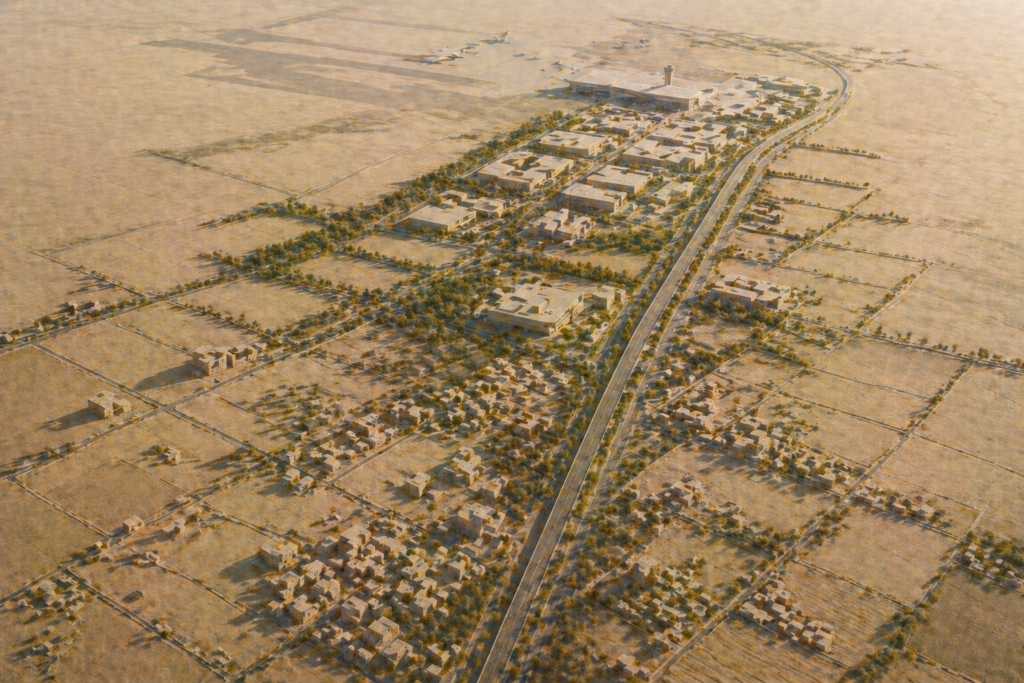
Our wider analysis of Bangalore’s peri-urban frontier established that the metropolitan edge behaves less like a conventional real estate market and more like a territorial negotiation between landscape, institutions, and capital. Within that framework, urban expansion corridors are the specific geographic channels through which this negotiation produces its most consequential outcomes for land investors. A corridor is not simply a road with land on both sides. It is a convergence of infrastructure investment, administrative decision-making, and market expectation that collectively determine whether a stretch of agricultural landscape will urbanise within a decade or remain functionally rural for a generation.
Understanding the economics of expansion corridors requires separating three distinct value creation mechanisms that operate at different timescales and with different certainty. Infrastructure-driven value creation, which responds to committed government investment in roads, utilities, and transit, is the most reliable mechanism because it reflects physical capital whose completion can be monitored. Planning-driven value creation, which responds to master plan designations and zoning changes, is less certain because it depends on administrative decisions that can be revised. Demand-driven value creation, which responds to the accumulation of employment and population in adjacent zones, is the most lagged but ultimately the most durable because it reflects the organic economic forces that infrastructure and planning are intended to serve.
The System Mechanism
The economic mechanism through which urban expansion corridors create land value operates through the reduction of development friction as each successive element of the enabling infrastructure and regulatory framework is put in place. Agricultural land that lacks road access, utility connections, DC conversion, and planning authority layout approval carries maximum friction and minimum development value above its agricultural use. As each friction element is removed, the land’s accessible development potential increases and its market value reflects the probability-weighted present value of the development returns that accessibility unlocks.
The infrastructure investment timeline is the primary determinant of the corridor’s value creation velocity. A corridor whose road widening, power supply augmentation, and water supply extension are committed in a government capital programme with specific completion timescales provides investors with a more reliable basis for value projection than a corridor whose infrastructure is anticipated but not yet committed. The distinction between announced and committed infrastructure investment is the difference between speculative and patient capital deployment, as examined in the STALAH Journal’s capital discipline series.
The Karnataka Town and Country Planning Act 1961 governs the planning framework within which corridor development occurs. Master plan designations under the BMRDA Master Plan 2031 determine the land use categories applicable to specific corridor zones, distinguishing between residential, commercial, industrial, agricultural, and ecological buffer designations that determine the permissible development for each parcel within the corridor. DC conversion under Section 95 of the Karnataka Land Revenue Act 1964 is the administrative mechanism through which individual parcels within a corridor transition from agricultural classification to developable status, following the master plan’s general direction but requiring specific parcel-level administrative action.
The Administrative and Physical System
The Bangalore Metropolitan Region Development Authority’s Master Plan 2031 establishes the spatial framework for corridor development across the metropolitan region. The plan identifies satellite town ring corridors, industrial zones, residential expansion areas, and ecological buffers that collectively define where urbanisation is anticipated and where it is restricted. The plan’s designations are not self-executing; they require the sequential completion of the administrative processes that convert planning intent into development permission for individual parcels.
Infrastructure provision in expansion corridors typically follows a sequenced pattern determined by the public authority’s capital programme priorities. Road widening and surface improvement typically precede electrical substation augmentation, which precedes water supply network extension, which precedes sewer infrastructure. Each stage of this sequence increases the corridor’s attractiveness for private investment while simultaneously increasing the competition for available land, progressively compressing the window during which patient capital can acquire at below-development-value pricing.
The Satellite Town Ring Road project, whose alignment connects the metropolitan fringe settlements around Bangalore at distances of roughly thirty to sixty kilometres from the city centre, represents the most significant infrastructure investment defining the next generation of corridor geography. The STRR’s completion would enable direct freight and passenger movement between the corridor nodes without requiring passage through the congested metropolitan core, fundamentally improving the regional accessibility of the corridors it serves and creating the connectivity that makes satellite town development economically viable for a broader range of enterprise and residential uses.
The Operational Consequence
The operational consequence of corridor economics for land investors is the creation of a temporal arbitrage opportunity whose window closes progressively as infrastructure is delivered and market recognition follows. The investor who identifies a corridor’s development trajectory before infrastructure commitment is reflected in land prices, acquires at agricultural value, and holds through the infrastructure delivery period to realise development-value pricing, captures the full value creation of the corridor’s transition. The investor who enters after infrastructure is committed but before completion captures a portion of the remaining value creation. The investor who enters after infrastructure delivery and market recognition has been established is acquiring at or near development value without the upside of the transition period.
The risk profile of each entry point differs as dramatically as the return profile. Pre-commitment entry carries maximum administrative timeline risk: the infrastructure may be delayed, revised in alignment, or cancelled, leaving the investor with agricultural land in a corridor that did not develop as anticipated. Post-commitment, pre-completion entry carries moderate risk, primarily related to the execution timeline and the rate of private investment following public commitment. Post-delivery entry carries minimum administrative risk but maximum price risk, as the market has already priced most of the infrastructure’s value contribution.
For family offices and institutional investors evaluating peri-urban corridor positions in Bangalore, the selection of entry point is a governance decision as consequential as corridor selection. Entry at the pre-commitment stage requires the institutional capability to manage agricultural land positions across extended holding periods with active governance, as described in the STALAH Journal’s analysis of patient capital and land banking. Entry at the post-delivery stage requires the analytical capability to identify value that the market has not yet fully priced into specific parcels despite having priced the corridor’s general trajectory.
The STALAH Interpretation
In practice we observe that the most consistent value creation in Bangalore’s expansion corridors has accrued to investors who combined corridor identification discipline, legal quality discipline, and holding period discipline simultaneously. Investors who identified the correct corridor but acquired legally deficient land destroyed value through litigation and remediation costs that consumed the geographic appreciation. Investors who acquired legally clean land in the correct corridor but could not sustain the holding period to value realisation sold before the infrastructure they anticipated arrived. Only the combination of all three disciplines produced the compound returns that the corridor economics describe.
A disciplined investor therefore approaches expansion corridor investment with a framework that is equally rigorous about corridor selection, title verification, and capital structure. The corridor selection framework identifies the specific infrastructure commitments and planning designations that support the value creation thesis. The title verification framework, drawing on the comprehensive methodology documented in STALAH’s Pillar I series, confirms freedom from PTCL Act restrictions, Karnataka Land Reforms Act encumbrances, and ancestral ownership fragmentation. The capital structure framework ensures that the holding vehicle has the patience and financial capacity to sustain the position through the full infrastructure delivery and market recognition cycle.
Over time the evidence suggests that corridor investments structured with all three disciplines produce MOIC multiples that exceed those achievable in the established commercial and residential markets, reflecting the compensation for the genuine governance intensity that corridor investment requires. The compensation is real because the governance intensity is real: most participants in the corridor market do not apply all three disciplines consistently, and their failure creates the pricing inefficiencies that disciplined capital can exploit.
The Risk Ledger
Infrastructure alignment revision is the highest-consequence risk in corridor investment. A road widening, metro line, or industrial estate that is announced with a specific alignment and then revised before completion can shift value creation from one side of a corridor to the other, stranding positions that were correctly identified relative to the announced alignment but incorrectly positioned relative to the revised one. Section 11 notifications under the Land Acquisition Act 2013 can freeze parcels within the acquisition corridor while the alignment is being finalised, preventing development or disposal for the duration of the acquisition process.
Ecological buffer designation changes imposed by National Green Tribunal orders or revised planning authority master plans can reduce the buildable area of corridor land below the development potential assumed at acquisition. Several parcels in the North Bangalore expansion zone and the Sarjapur belt have been affected by retrospective buffer revisions that reduced permissible development intensity after land values had already reflected the pre-revision development potential.
Village-level litigation from ancestral ownership claims, partition disputes, and PTCL Act restoration applications is most concentrated in the peri-urban taluks that form the primary development front of Bangalore’s expansion corridors. The density of unresolved family inheritance complexity in the agricultural land of Anekal, Hoskote, Doddaballapur, and Devanahalli taluks creates a claims environment that systematically produces title complications in a fraction of any assembled portfolio, regardless of the care taken in initial verification.
STALAH Knowledge Graph Links
This analysis connects to the examination of the Sarjapur transformation, which provides a specific corridor case study illustrating the value creation sequence described here in general terms. The treatment of the Devanahalli corridor addresses the aerospace-anchored corridor whose infrastructure commitment profile most clearly demonstrates the pre-commitment to post-delivery entry point distinction. The examination of Rajakaluve drainage buffers and development risk addresses the ecological constraint mechanism that most consistently reduces developable area below gross land area in corridor positions across the metropolitan fringe.
Practical Audit Questions
Questions a disciplined investor should raise when evaluating a corridor land position include: What specific infrastructure investments underpin the value creation thesis, and have these been confirmed as committed in government capital programmes rather than announced in policy documents without budget allocation. At what stage of the infrastructure delivery sequence does the corridor currently sit, and what remaining friction elements must be resolved before the land reaches its projected development value. Has the comprehensive title verification described in STALAH’s Pillar I series been completed for each survey number in the position, confirming freedom from PTCL Act restrictions, Karnataka Land Reforms Act encumbrances, and ancestral ownership fragmentation. What is the holding structure, and does it have the financial capacity and duration flexibility to sustain the position through an infrastructure delivery timeline that extends two to three years beyond the base case. Has the ecological constraint profile of the position been assessed against current BMRDA Master Plan 2031 designations and applicable National Green Tribunal orders, confirming that no buffer designation applies to portions of the position that are included in the development potential calculation.
Related Reading
Frequently Asked Questions
Which Bangalore corridors offer the best land value appreciation potential in 2026–2031?
The Sarjapur-Attibele corridor offers strong appreciation potential driven by IT/GCC demand and the forthcoming ORR extension. The Devanahalli corridor retains medium-to-long-term upside tied to the aerospace SEZ and BIAL expansion, though it remains early-stage for residential. Hosur in Tamil Nadu offers near-term industrial land appreciation anchored by Tata Electronics and Ola Electric. North Bangalore’s Thanisandra-Yelahanka belt benefits from metro Phase 2 and proximity to established employment, making it the strongest near-term residential appreciation play among peripheral corridors.
How does confirmed metro route alignment affect land prices in Bangalore’s expansion corridors?
Confirmed metro route alignment, defined as inclusion in the sanctioned DPR and cabinet approval, typically triggers a 15-25% land price increase within 500 metres of station locations within 6-12 months of announcement. The gap between announcement and commissioning in Bangalore has averaged 6-10 years for recent phases, meaning early land banking near unbuilt stations requires patient capital with a 7-10 year horizon to capture the full infrastructure-driven value cycle.
What is the typical time lag between infrastructure announcement and land price increase in Bangalore?
Speculative land price increases typically begin within 3-6 months of a credible infrastructure announcement — such as DPR approval or government budget allocation. A second and larger appreciation wave occurs 12-24 months before infrastructure commissioning, when project completion becomes tangible. Investors who buy at the initial announcement phase and hold through commissioning capture the full return cycle. Those who buy after the first wave but before commissioning still capture meaningful appreciation, though at a compressed IRR relative to first-movers.
Arpitha is the founder of Stalah, a principal-led real estate house shaped by clarity, discretion, and long-term thinking. Her approach focuses on selective mandates, thoughtful representation, and measured real estate decisions.
Related Reading: